Household Ants & Carpenter Ants Control Guide: Effective Tips & Solutions
- Carpenter ants don’t eat wood — they excavate it to build smooth-walled nesting galleries, and that silent damage can go unnoticed for years.
- Spring ant activity isn’t a new infestation — colonies have been present all along; warmer temperatures simply push them into the open.
- Most DIY sprays only kill visible ants and rarely reach the colony, making the problem worse over time by splitting or dispersing it.
- Locating the nest is the single most important step in any effective ant control strategy — everything else is just temporary relief.
- Carpenter ants often have satellite nests indoors connected to a parent colony outside, which is why treating only what you can see almost never works.
If you’re seeing ants in your home every spring, you don’t have a seasonal nuisance — you have a colony that’s been quietly growing, and it’s time to deal with it properly.
Many homeowners fall into the same trap: they reach for a can of bug spray, kill the visible ants, and think they’ve solved the problem. A week later, the ants return. The reason this cycle continues is simple — you need to know what kind of ant you’re dealing with and where it’s actually nesting. We at TNR Exterminators specialize in identifying and eliminating ant infestations at the root, not just on the surface.
Ants in Your Home Are Not a Random Occurrence
Ants don’t just stumble into your home. They follow exact chemical paths set down by scout ants who have already plotted a course to a food or water source inside your home. When you see a trail traversing your kitchen counter, that path has likely been set for days, maybe even weeks.
When the weather starts to warm up in the late winter and early spring, ant colonies that have been dormant during the cold months become active again. About 15 minutes after the sun goes down, worker ants start to leave the nest and aggressively follow existing trails. So, if you suddenly see ants near your windows, baseboards, or kitchen sink, it’s not a new invasion. The colony was already there.
Comparing Household Ants and Carpenter Ants: What Sets Them Apart?
Ants in your home can be a nuisance, but not all ants pose the same level of threat. While common household ants like sugar ants and pavement ants are mainly interested in your food scraps and grease, carpenter ants are a completely different issue. The type of ant you are dealing with will dictate your response.
Physical Characteristics
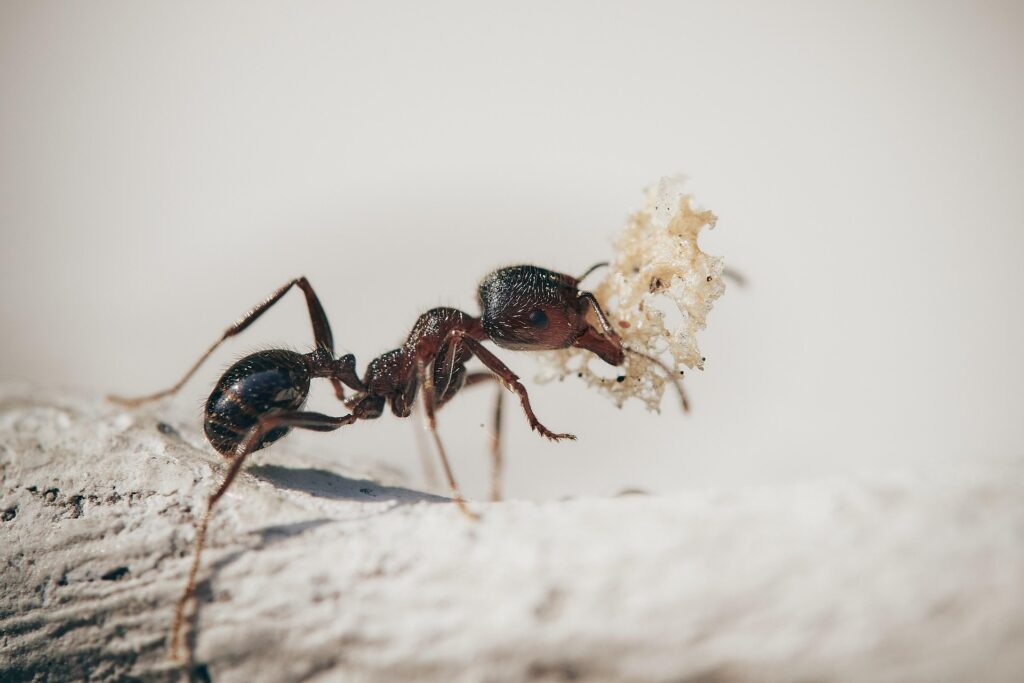
Of all the pest ants in the United States, carpenter ants are the largest. The black carpenter ant (Camponotus pennsylvanicus), which is most commonly found in the Midwest and Northeast, is black, wingless, and its workers are between ¼ and ½ inch long. That’s significantly bigger than the tiny pavement or sugar ants you typically see near a crumb on the floor. It’s important to note that size and color can vary even within the same carpenter ant colony, so the most reliable identification feature is the carpenter ant’s smoothly rounded thorax when viewed from the side.
The Greater Danger of Carpenter Ants
Carpenter ants differ from termites in that they don’t consume wood, but rather burrow into it to create smooth, clean nesting galleries. They specifically target wood that is already damp or structurally compromised, such as window frames, roof eaves, wall voids near plumbing leaks, or wood in contact with soil. Over time, large colonies that are excavating galleries through structural members can cause significant damage. While carpenter ants are generally considered more of a nuisance than an immediate structural threat like termites, it’s never a good idea to ignore an established colony.
While carpenter ants do provide a beneficial service to the environment by decomposing dead wood in logs and stumps outdoors, they can become a nuisance when they establish satellite colonies inside buildings. This is a more common occurrence than many homeowners might think.
Identifying Carpenter Ant Frass vs. Regular Ant Trails
Carpenter ants are known for leaving a unique signature called frass — a combination of sawdust-like wood shavings, pieces of insects (legs, wings), and other debris they expel from their galleries. Discovering this substance near baseboards, windowsills, or wall voids is one of the most obvious signs that carpenter ants are currently nesting in your house. Ordinary household ants do not leave this type of material. The table below highlights the main differences for easy comparison:
| Feature | Nuisance Ants (Kitchen/Pavement) | Carpenter Ants |
|---|---|---|
| Size | Small (1–2 mm) | Large (6–12 mm) |
| Color | Brown, black, or reddish | Dark brown to black |
| Primary reason indoors | Food and moisture | Nesting in moist/damaged wood, plus food |
| Damage risk | Food contamination only | Wood damage over time |
| Frass present | No | Yes — sawdust mixed with debris |
| Peak activity | Daytime trails near food | Mostly nocturnal, 15 min after sundown |
Once you’ve identified which ant you’re dealing with, every next step becomes clearer — from where to look for the nest to which treatment approach will actually work.
Red Flags That Indicate You Have an Ant Infestation
Some ant infestations are easy to spot. Others remain concealed within walls for months before a homeowner becomes aware of the magnitude of the situation. These are the signs you should be on the lookout for.
Springtime Indoor Winged Swarmers
One of the most alarming signs of an established carpenter ant colony nesting within your home is the sight of large, winged ants emerging indoors, especially in the spring. Swarmers, or alates, are reproductive ants that appear when a colony is mature enough to expand. If they’re appearing indoors instead of outside, it’s almost certain that the parent or satellite nest is inside the building, not just near it.
Nocturnal Noise Inside Your Walls
When the sun sets, carpenter ants get to work. As they tunnel through the wood in your walls, they create a quiet, yet noticeable, rustling noise that’s been likened to the sound of crinkling cellophane. If you tap on the wood where you suspect they’ve set up shop, you might hear the noise get louder for a moment as the colony is disturbed. Don’t ignore this sound if you hear it at night near a wall, beam, or door frame.
Little Mounds of Sawdust by Wooden Structures and Window Sills
Discovering tiny mounds of something that resembles rough sawdust near baseboards, door frames, or wooden structural components is a clear indication of carpenter ant tunneling. This frass piles up at their gallery exits. Importantly, the location of the sawdust mound doesn’t always point directly to the nest — the actual colony could be several feet away through the wall. The frass is a clue that tells you to investigate further, not an end point.
Locating the Nest
Locating the nest is not a choice — it’s the entire point. Spraying pesticide around a foundation or visible trails without finding the colony is a common and expensive error made by homeowners. It only kills worker ants temporarily while the queen continues to produce thousands more.
One of the best methods is to patiently observe. Keep a close eye on the ant trails, especially at night when carpenter ants are most active. Follow the trail without disturbing it and take note of where the ants vanish – into a crack in the wall, behind a baseboard, under a door frame. If they disappear into a wall, the nest could still be several feet away in any direction, so don’t just stop at the entry point.
Finding Ant Trails in the Evening
Take a flashlight and go outside about 15 minutes after the sun goes down. The carpenter ant workers will be busily moving along their established chemical trails in search of food. Don’t spray anything you see. Instead, follow the trail in both directions — toward the food and back toward where the ants are coming from. That return direction will lead you to the nest. Mark the entry point and use it as your starting point for your investigation the next day.
Where to Find Indoor and Outdoor Nests
Most carpenter ant colonies work on a two-nest system. The main nest — home to the queen, eggs, and larvae — is usually located outdoors in a pile of wood, a decaying stump, a dead tree, or a log, sometimes several feet above the ground. The secondary nest is what forms indoors, usually in wall voids, hollow doors, window frames, or insulation near a water source. Workers travel between both nests constantly. If you only get rid of the indoor secondary nest, you’ll have some temporary relief, but the outdoor main colony will reinfest the structure. You need to address both.
Steps to Prevent Ants that Every Homeowner Should Take
Preventing an ant infestation is far less expensive and less disruptive than treating one. The conditions that attract both household ants and carpenter ants are almost always preventable — and most of them boil down to food, moisture, and entry points.
The following steps address all three of these factors methodically. You don’t have to do them all in one go, but the more of them you put into action, the less welcoming your home will be to any species of ant.
1. Get Rid of Food Sources in Your Home
Keep all food items in your pantry — especially items like sugar, grains, and pet food — in containers that are sealed and hard-sided. Regularly wipe down your counters, the edges of your cabinets, and your stovetops to get rid of any grease or food residue. Don’t let dirty dishes sit in your sink overnight. While these might seem like basic steps for keeping your home clean, they also help to get rid of the chemical signals that scout ants use to bring an entire trail of ants to your home in just a few hours.
2. Address Moisture Issues
Carpenter ants are attracted to moist, damaged wood, not dry, healthy wood. If you have any leaky pipes under your sinks or near your appliances, fix them as soon as possible. Make sure your roof eaves, gutters, and downspouts are properly draining water away from your foundation. Any wood that is consistently damp, whether from a slow leak, poor grading, or condensation, is a prime target for carpenter ants and should be fixed or replaced.
3. Close Up Any Cracks, Gaps, and Entry Points
Ants can squeeze through the tiniest of gaps. Do a thorough inspection of your home’s exterior and fill in any cracks in the foundation, gaps around utility lines and pipes, and spaces under door frames with suitable caulk or expanding foam. Be sure to check where any utility line — whether it’s electrical, plumbing, or cable — enters the building, as these are often forgotten entry points for ants.
4. Eliminate Outdoor Nesting Sites Close to Your Home
Woodpiles leaning against the house, old tree stumps in the yard, buried scrap lumber, and decaying logs are all ideal homes for carpenter ant parent colonies. Relocate firewood storage a minimum of 20 feet away from the structure and raise it off the ground. Remove stumps and dead trees that are near to the home. This immediately lowers the chance of an indoor satellite colony forming.
5. Prune Trees and Bushes Close to the Building
Branches and bushes that touch the outside of your house create bridges. These bridges are not just for carpenter ants, but for almost all typical household pests. Make sure tree branches are pruned back from the roofline and no plants are touching siding, eaves, or window frames directly. Ants use plant paths to go directly onto and into buildings without ever touching the ground where a perimeter treatment might stop them.
Do-It-Yourself Methods and Their Limitations
While there are effective do-it-yourself methods for small-scale household ant issues, they have significant limitations, particularly when dealing with carpenter ants. Knowing what each method does can prevent you from wasting time on treatments that won’t address the root of the issue.
How to Use Ant Bait Effectively
Ant bait is one of the most effective DIY solutions for ant control, but only if used correctly. The bait works by allowing worker ants to carry the toxic material back to the colony, where it is then shared with other workers and, hopefully, the queen. Products like Terro T300 Liquid Ant Bait use borax as the active ingredient and are effective for sugar-feeding household ants like odorous house ants and pavement ants. The bait stations should be placed directly on active trails, not away from them. Avoid spraying anything near the bait, as killing forager ants before they carry the bait back would defeat the purpose.
Using bait for carpenter ants is generally slower and less reliable than treating the nest directly. However, it can help reduce the colony if you place it along active trails near suspected nest sites. You can get gel baits and granular baits that are specially formulated for carpenter ants, but you need to be patient. It can take days to weeks to see a significant reduction. Never use bait and a contact spray in the same area. Choose one method and stick with it.
The Downside of Contact Sprays
Contact sprays only kill the ants they come into contact with. The residue they leave behind can actually cause the ant colonies to change their paths, sometimes creating multiple new paths that are even more difficult to track. This process is known as budding and can turn one ant problem into several. This is particularly problematic with carpenter ants. Using contact sprays around the foundation of your home or in open attic spaces does little to control the colony and can expose your household to unnecessary pesticides. Contact sprays should only be used for targeted use, not as a perimeter treatment when there is an active colony.
When Do-It-Yourself Methods Aren’t Enough for Carpenter Ants
Let’s be honest: if you’ve got a full-blown carpenter ant infestation in your walls, DIY methods usually don’t cut it. To get to the nest, you often need to drill into wall voids, door frames, or window frames and inject dust or liquid insecticide directly into the gallery system. That’s not something a consumer spray can or bait station is meant to do. Products like Delta Dust (deltamethrin) or Termidor Foam (fipronil) can be very effective when injected into confirmed void spaces — but finding those voids accurately and safely applying the product takes training and experience.
You must also treat the main colony outside the structure at the same time. If you don’t deal with outdoor nest sites in stumps, woodpiles, or trees at the same time as indoor satellite nests, you’re almost certain to have a reinfestation within the same season. A professional inspection will identify both nest locations, confirm the species, and apply the correct combination of treatments to break the entire colony system — not just the part you can see.
Commonly Asked Questions
Here are the questions homeowners most frequently ask about ants — answered based on actual ant biology and colony behavior.
How can I tell if I have carpenter ants or termites?
People often mix up carpenter ants and termites, but they have distinct physical traits. Carpenter ants have a pinched waist that is clearly segmented, antennae that are bent, and if they have wings, during their reproductive cycle, the front ones are significantly larger than the back ones. Termite swarmers, on the other hand, have a thick waist with no pinch, antennae that are straight and look like beads, and wings that are all the same size.
The destruction they create is also markedly different. Carpenter ant galleries are polished, neat, and have an almost sandpapered look because they remove wood debris (frass) from the galleries. Termite damage is ragged and filled with dirt or mud. If you discover frass — a combination of coarse sawdust and insect parts — near damaged wood, it’s far more likely to be the work of carpenter ants.
Why do ants suddenly appear in spring?
Ants don’t suddenly appear in spring — they were already there. Ants are less active in cooler temperatures, so you don’t see them as much in the winter. When it starts to get warmer, the ants become more active, and you start to see them in your home again. The sudden appearance of ants isn’t a new infestation; it’s an existing one becoming active again.
Is it possible to eliminate carpenter ants without drilling holes in the walls?
In some instances, it is possible, especially if the satellite nest is reachable or if the colony is still in its early stages and primarily located outdoors. Direct treatment of the outdoor parent nest, removal of nesting habitat, and targeted bait application along active trails can sometimes reduce or even completely eradicate the problem without the need for invasive wall treatment. However, if carpenter ants have been present for more than one season, if you’re hearing activity within the walls, or if frass continues to reappear after surface treatments, it’s almost certain that drilling and direct void injection will be necessary in order to effectively reach the nest.
Can I safely use ant baits around my kids and pets?
Most ant bait products you can buy — like Terro T300, which is made with borax — are not very toxic to mammals if you use them the right way. The amount of active ingredients in bait stations is kept low on purpose. This is so the ants can take the bait back to their colony without dying right away. But, you should always put bait stations where children and pets can’t get to them. This could be behind appliances, inside cabinet hinges, or along the edges of walls where pets and small children can’t reach. You should always read and follow the directions on the label. When it comes to using pesticides, the label is the law.
How distant can a carpenter ant nest be from my home?
Surprisingly, carpenter ant parent colonies can be situated quite a distance from the structure they are infesting. They can sometimes be found 100 yards or more away, in a neighboring tree, rotting stump, or woodpile. Workers will travel significant distances along established chemical trails to reach food and satellite nesting sites within buildings. This is one of the main reasons why locating the parent nest can be so challenging without professional experience.
On the other hand, an indoor satellite nest is almost always linked to a source of moisture within the building – a pipe that leaks, a damp wall cavity, or a window frame damaged by water. Locating and addressing this moisture issue is often the quickest method to make an indoor nesting location uninhabitable, which can force the satellite colony to leave even before the parent nest is directly treated.
If the main nest is outside and the secondary nest is inside, getting rid of just the inside nest will only provide a temporary solution. If the source of moisture and entry points are not dealt with, worker ants from the outside nest will return and recreate the secondary nest, often in the same place, within weeks.